T14N4
Содержание


Study of novel organic optoelectronics materials based on thiophene and silicon by time-of-flight laser desorption/ionization mass spectrometry
T14N4
A.P. Pleshkova, E.S. Kuznetsova
The results of investigation of a variety of new organic semiconductors for optoelectronics based on thiophene and silicon by time-of-flight direct laser desorption/ionization mass spectrometry are given. The peculiarities of behavior of these species were analysed. The main route of ionisation for many of the compounds was found to be the only formation of molecular radical cation. For a small group of species, protonation and deprotonation were observed rather than the above path.
However, there were some molecules for which several competing routes were detected, namely, the generation of molecular radical cation, protonation and deprotonation.
Development of ion current measurement and recording system for MI1201IG mass spectrometer
T14N4
V.V. Kolobov, V.N. Selivanov, M.B. Barannik
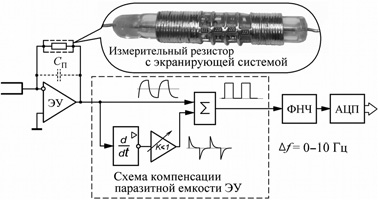
We performed complex modernization of the MI1201IG mass spectrometer. Ion current measuring and recording system was designed. The new system consists of electrometric amplifier and recording system with high-precision analog-to-digital converter. The electrometric amplifier is based on the specialized integral microcircuit and high-resistance (1 TOhm) measuring feedback resistor. The electrometric amplifier is placed in electrometer head. The recording system is located in a new separating magnetic field control and ion current measuring unit. The new ion current measuring and recording system was developed not only to increase sensitivity and expand the dynamic range but also to decrease the time constant of the analog part of the measuring system. Reducing the time constant is necessary for an undistorted ion current signal transmission to ADC input in full-scan mode. Special shielding system to distribute the electric field gradient on surface of the high-resistance feedback resistor was designed. This allowed the compensation of a distributed capacitance of the feedback measuring resistor and the reduction of the time constant of the electrometer to 0.2 sec. The time constant value is determined by the value of in-to-out stray capacitance of the electrometer’s amplifier chip. Therefore, a parasitic capacitance compensation circuit was developed. As a result, the end-to-end frequency response of ion current measuring and recording system is determined only by the upper cutoff frequency 10 Hz of low-pass filters. The usage of the new measuring system allowed us to increase the mass spectrometric resolution, mass accuracy and full-spectrum scan speed. The measuring range of ion currents is 1 × 10–15 – 3 × 10–12 А. The measured equivalent input root-sum-square of noise is 0.86 fA at sampling frequency of 10 Hz and integration time of 1 sec. The measured equivalent input root-sum-square of noise is 0.14 fA at sampling frequency of 10 Hz and integration time of 10 sec.
Improved procedure for tandem gas chromatography/mass spectrometry detection of the globin adduct of sulfur mustard
T14N4
N.L. Koryagina, M.D. Shachneva, A.I. Ukolov, E.I. Savel’eva, N.S. Khlebnikova, A.S. Radilov
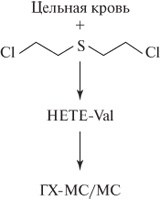
Features of electron and chemical ionization mass spectra of derivatives of N-[2-[(hydroxyethyl)thio]ethyl]-DL-valine (НЕТЕ-Val)—a biomarker of sulfur mustard (SM) — recorded by GC-MS and GC-MS/MS were studied. The retention indices of the studied derivatives were measured. The optimized procedure of the GC-MS/MS (MRM mode) identification of НЕТЕ-Val was tested in the analysis of donor blood samples exposed in vitro to sulfur mustard. The linear range of the detector was 10 to 100 ng mL– and the detection limit was 10 ng mL–1 for SM.
Determination of the structure of alkyl radicals in the series highly toxic organophosphorus compounds using mass spectrometry databases and Library Search
T14N4
A. V. Dudkina, Yu.I. Morozik, I.V. Rybal’chenko, A.G. Terentyev
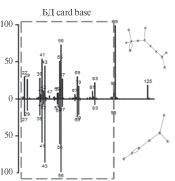
On the basis of the discovered regularities in the formation of mass spectra of monofunctional compounds RX (R – alkyl radical, X-functional group), an approach to the identification of alkyl radicals attached to ether oxygen atom in the series of highly toxic organophosphorus compounds is proposed. The approach is based on the extraction of the hydrocarbon sub-spectrum from the mass spectrum of the analyte and its comparison with the hydrocarbon sub-spectra of known monofunctional compounds. Identification of alkyl radicals is carried out using simple metrics that characterize the coincidence of hydrocarbon subspectra. The results of the identification of alkyl (cycloalkyl) radicals in the series of O-alkyl(cycloalkyl)alkylphosphonofluoridates, and O-alkyl(cycloalkyl)-N,N-dialkylphosphoramidocyanidates show that ≥ 95% of the structures of the radicals of these compounds are within 10 positions of the search answer.
A new post-chromatographic derivatization approach to identification of alcohols and phenols in complex mixtures by a combination of planar chromatography and matrix-assisted laser desorption/ionization mass spectrometry
T14N4
C.A. Esparza, N.Yu. Polovkov, R.S. Borisov, A.V. Varlamov, V.G. Zaikin
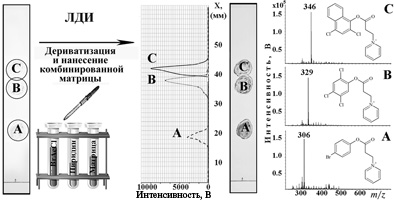
Simple and suitable approach for post-chromatographic derivatization in the analysis of mixtures of alcohols and phenols by combination of thin-layer chromatography and MALDI mass spectrometry was suggested for the first time. Chemical modification of analytes was accomplished by the treatment of eluted zones on thin-layer chromatograms by 3-bromopropionyl chloride in the presence of excess of a base (pyridine or triethylamine). The resulting derivatives contained a residue with fixed charge (ammonium fragment) that provided an efficient desorption of derivatized analytes from the sorbent layer during MALDI. It was shown that the suggested approach allows the recording of mass spectra with high signal/noise ratio and the detection of alcohols and phenols of different structures. Reproducibility of such MALDI mass spectra is rather high which predetermines a possibility to build the chromatogram curves using total or selected ion current and, hence, their visualization and treatment on quantitative level.
Detection of metabolites of furanylfentanil, the new psychoactive substance, in rat urine and serum by liquid chromatography/mass spectrometry
T14N4
I.A. Rodin, S.E. Gribkova, A.M. Grigoryev, E.V. Nikitin, V.A. Kalashnikov
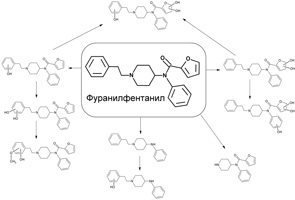
The appearance of new psychoactive substance furanilfentanil [N-phenyl-N-(1-(2-phenylethyl) piperidin-4-yl) furan-2-carboxamide] in the market necessitated the determination of its chromato-mass spectrometric characteristics, as well as its metabolites, for the subsequent automated control of them in biological objects. The structure of the furanylfentanyl molecule has a significant similarity with fentanyl and its structural analogues. This article describes the detection of metabolites of furanylfentanil in urine in laboratory rats and presents data on their proposed structures. Using high-resolution liquid chromatography/mass spectrometry, a number of metabolites were discovered in urine. Among them there are the products of monohydroxylation of phenylethane and N-phenyl residues; dihydroxylation and dihydroxylation combined with methylation of the phenylethane; formation of dihydrodiol and additional hydroxylation; N-dealkylation; hydrolysis of the amide bond and additional hydroxylation. Using chromatography/mass spectrometry characteristics of furanilfentanil and its metabolites which were founded in rats urine earlier, a number of them as well as furanilfentanil itself were also discovered in postmortem blood and urine samples of humans. It has been established that the main route of biotransformation of furanylfentanyl, in both humans and rats, is a monohydroxylation of the phenylethyl fragment, formation of dihydrodiol and hydrolysis. Presented mass spectra and retention characteristics of founded metabolites can help in the detection of these (or corresponding compounds) in biological human fluids
Characterization of disinfection by-products in tap water of Arkhangelsk by liquid chromatography/high-resolution mass spectrometry
T14N4
D.S. Kosyakov, N.V. Ul’yanovskii, M.S. Popov, T.B. Latkin, A.T. Lebedev
Disinfection of drinking water with chlorine-containing reagents leads to the formation of a large number of disinfection by-products resulting from the chlorination of natural dissolved organic matter. High-performance liquid chromatography/high-resolution mass spectrometry with preliminary solid-phase concentration on a polymeric sorbent was used to study the component composition of halogen-containing disinfection by-products in the tap water in Arkhangelsk. Fourteen chlorinated and brominated organic compounds belonging to classes of halophenols, aromatic acids and carbonyl compounds, chlorine-substituted nitrogen-containing heterocyclic compounds have been found. Based on the analysis of MS/MS spectra data, the possible structures of detected disinfection by-products are proposed.